How I Make Performance and Education Work in the Jazz World
An Interview with Vandoren Artist Kris Allen
Date Posted: April 11, 2018
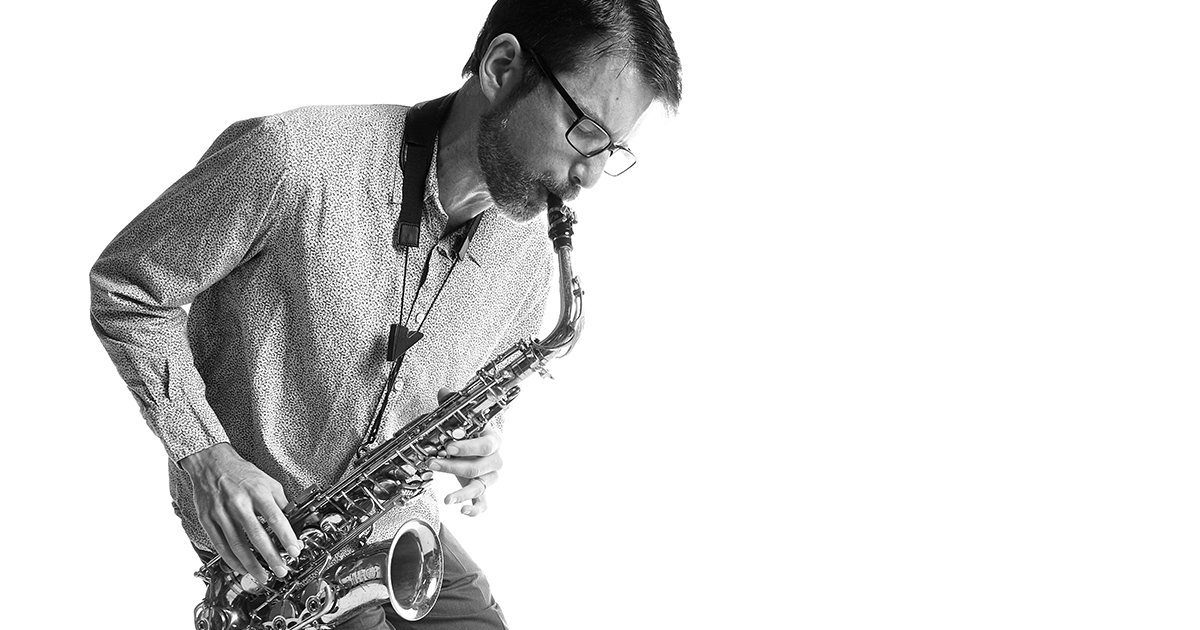
You began playing music as a classical pianist – what led you to the alto saxophone? Did you transition to classical saxophone before jazz? What types of parallels do you find when comparing piano and saxophone as well as classical and jazz?
My mother had gotten me started with the piano at a very young age, but the saxophone was something that I got into through the band program at my elementary school.
Many of my early ‘saxophonic experiences’ were in concert bands, so that was classical in nature, but I never really seriously pursued the modern solo literature that is out there for the classical saxophone.
I had the privilege of studying with a terrific classical saxophonist named Ken Radnofsky for several years in college, and he helped me with a whole host of technical issues pertaining to the way I was approaching the instrument. I still play quite a bit of piano, and do almost all of my composing and arranging there.
Speaking as an educator, I feel that knowing one’s way around the piano has come to be justifiably considered one of the indispensable disciplines of jazz study. There is no other way to see the voice leading between chords. Obviously, there are many parallels between classical and jazz music, and I have been in many performing situations that stylistically straddled the line between these genres.
Ultimately, I think the same core factors account for powerful and emotive music making regardless of style, genre, etc: Beautiful and compelling tone, and a command of time.
You studied at the Hartt School of Music. What was it like to work with Jackie McLean? Your peers at Hartt, also prominent jazz musicians, were quite influential. Who were they? How did you contribute to each others’ learning? Are you all still close?
Jackie was one of the most important people in my life. My relationship with him was the major factor propelling me to choose a life in music. At the Hartt school Jackie taught and interacted with all of his students in a manner consistent with jazz’s aural tradition; that is to say we learned by doing, by listening, playing and imitating.
I certainly also learned so much from my fellow students, perhaps most significantly from other saxophonists. Jimmy Greene, Wayne Escoffery, Julius Tolentino and I were roommates for three years, and spent almost all of our time together. We were very serious about the music and encouraging towards one another. Those guys will always be special to me, and I’m happy to say that yes we are all still close.
What is your favorite part about performing and teaching?
I’d have to say the music itself! I’m fairly addicted, for better or worse. Since you are perhaps asking about the interaction between the two, I’ll say that I see many ways that one feeds the other. Certainly the performing brings knowledge and credibility along with a very deliberate, organized and thorough mindset when considering all sorts of artistic decisions.
"I think a musician just needs a well-formed concept of how he/she wants the music to sound, and good communication skills in order to share that vision." - Kris Allen
Can you tell us a bit about your experience as Artist in Residence at Williams College?
I’ve really enjoyed my time at Williams, which amounts to just over a year at this point. An Artist-In-Residence position is just another flavor of professor, but I really like that title and all that it implies. I work with a relatively small group of students there, about 20 all told, and I often have each student for multiple years in ensembles and classes, which is a treat. Our music department there is terrific; really large and accomplished, with a tradition of excellent performing groups, so I feel proud and humbled to be a part of it. I have some fantastic students there and I’m trying to create more opportunities with which to show them off!
What would you like our readers to know about the Litchfield Jazz Camp?
That every student who attends has fun, and that any student of any skill or experience level will feel at home there and be given every opportunity and resource necessary to improve. It’s a very nurturing and welcoming environment, and a family of sorts. I’ve been involved for over fourteen years and it’s nice to have that summer “home away from home.” So many of the most important musical connections in my career as well as friends in my life can be traced back to the Litchfield camp.
Learn more about the Litchfield Jazz Camp.
You are currently leading your own quartet. What does the bandleader role entail? What are some of your responsibilities? What are some of the qualities you believe a musician needs to be good bandleader?
Today’s bandleader needs stubbornness, and a patient long view of the future. A willingness to sacrifice a bit to give a project life…. I think a musician just needs a well-formed concept of how he/she wants the music to sound, and good communication skills in order to share that vision. Shrewd decision making in terms of people, repertoire, and venues to pursue for work. I don’t think that I’ve cornered the market on any of these qualities, I’m still trying to learn!

About Kris Allen
Kris Allen is an American saxophonist, composer, educator, and recording artist.
His latest release, June, is his third album for the Truth Revolution Recording Collective. Praised by Carlo Wolff in Downbeat Magazine (4.5 stars) for it “Subtlety, suppleness and sense of urgency,” this “diverse and impassioned album” features Allen’s quartet with special guests Jeremy Pelt, Chris Dingman, Shenel Johns and Michael Mayo.
(See “Press” for the complete review, or “Merchandise” to purchase June and previous albums)
Kris can be found touring widely as a leader or as part of the collaboratively-led “Triangle Offense” trio with Jonathan Barber and Matt Dwonszyk. He has also enjoyed a long career as a sought-after sideman, working in the groups of Illinois Jacquet, Gerald Wilson, Andy Gonzales, Jimmy Greene, Helen Sung, Winard Harper, Andy Laverne, the Mingus Dynasty, Avery Sharpe, Andy Jaffe, Earl Macdonald, Noah Baerman, Ike Sturm, Rogerio Boccato, Kendrick Oliver’s New Life Orchestra, the Curtis Brothers, and Mario Pavone among others. As a composer, Kris has been honored with numerous awards, commissions and residencies including a State of Connecticut Artist Fellowship and a Macdowell Artist Colony Residency. He has collaborated with dancers, poets, and visual artists, as well as musicians from across diverse genres.
A dedicated educator, Kris is the Lyell B. Clay Artist Artist-In-Residence in Jazz at Williams College, having previously held positions at the Hartt School, Trinity College, Southern Connecticut State University and the Greater Hartford Academy of the Arts. He has been a Teaching Artist for Litchfield Performing Arts since 2001, and conducted clinics and master classes at institutions nation and worldwide.
Kris is a Vandoren Artist and plays Vandoren mouthpieces, reeds and ligatures exclusively.