Practice Strategies for Neurodivergent Musicians: A Focus on ADHD
by Christopher Victor
Date Posted: October 05, 2026

Struggling to make traditional practice strategies work for you? Explore research-informed approaches to improving focus, managing practice time, navigating transitions, and building practice habits that work with your unique brain.
Discovering which practice strategies are effective is a task that all musicians face. With so many quick tips and tricks out there, it can be difficult to find what works best for you. This can be especially difficult for those of us whose brains don’t function the same way as most neurotypical people.
The goal of this article is to help those with neurodivergence use and discover other methods that will help make their practice sessions more enjoyable and efficient. Of course, any strategies presented here can help anyone, but they are research-informed strategies combined with my own personal experience as a musician with a neurodivergent brain.
Defining Neurodivergence
Let’s begin by defining neurodivergence. The Cleveland Clinic defines neurodivergence as a “nonmedical term that describes people whose brains develop or work differently for some reason”. This means that a person has different strengths and challenges compared with someone whose brain functions more traditionally (Cleveland Clinic, 2022).
Neurodivergence isn’t a standardized medical diagnosis, but examples commonly discussed under the term include (but are not limited to): autism spectrum disorder, attention deficit hyperactivity disorder (ADHD), dyslexia, and obsessive-compulsive disorder (Cleveland Clinic, 2022). There are many forms of neurodivergence, and if you are finding that typical practice strategies are not working for you, give some of the strategies below a try!
Using Stimulation Strategically
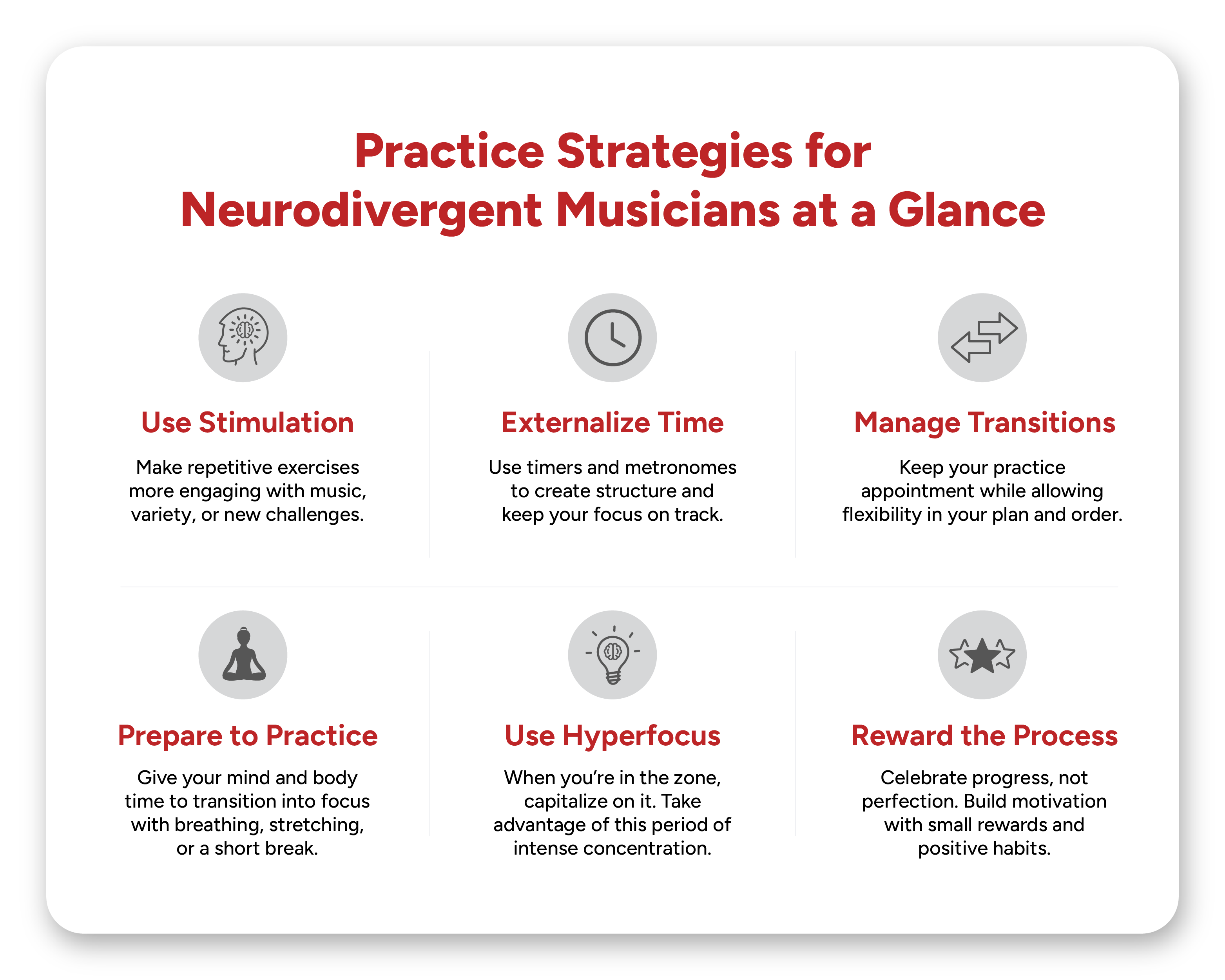
As someone with ADHD, I find warming up and working on fundamentals to be quite difficult to grab my attention. To compensate, usually, I will warm up with music on in the background. By doing this, we are not eliminating distraction, we are strategically using stimulation to make the task more tolerable. Whether that is Mozart or Taylor Swift, it helps the distracted part of my brain latch onto something I enjoy while the rest of my brain can focus on the activity.
I also try and use this during fundamental practice. Try playing your scales to the key of whatever song is playing and to the tempo of that song. Using the same song, you can focus on scales, intervals, articulation, air support, air direction, and just about anything else that comes to mind. I often like to use this method to practice extended techniques, too. New techniques can be very difficult and frustrating to learn, especially in the beginning.
As long as you can stay focused and aware of the technique you are learning, using stimulation strategically can be especially helpful to get over the hump of learning a new technique and staying motivated to keep learning it.
Externalizing Time: Using Timers and Metronomes
The most useful pieces of equipment in my practice sessions are my kitchen timer and portable metronome. I NEVER enter a practice session without these. Tools that provide structure without the possibility of distraction can make it much easier to stay engaged as these tools serve no other purpose. A phone or tablet can do this for you as well, but I still find them very distracting.
A kitchen timer and a portable metronome have a sole purpose and function: to count down time and to keep steady pulse.
I have a digital kitchen timer that I set for each session or section that I am working on. I am telling my brain that for the next 20 minutes I will be diligently focusing on the beginning section of “X” piece. Timer goes off, I check with myself and my schedule to see what I didn’t get to so that I can pick up in this section during another session.
Feel free to experiment with the duration of your timer. The amount of time I set the timer to varies from 5 minutes to 45 minutes depending on the activity. Then, I go to the next piece, section, technique, etc. and reset my timer. This helps me keep track of my practice time and gives each task a defined amount of attention.
Managing Transitions Into Practice
Other important factors I find when going into a practice session are consistency, routine, and mindset. I rarely find myself switching my schedule around to practice at an unscheduled time. My mind and body are not usually ready for me to do this. The issue is not an unwillingness to practice, rather a cognitive difficulty in transitioning from the current task into a high-focus activity.
I keep my sessions scheduled and planned so that I do not have to wrestle with this during the day or during the practice session. I will, however, switch up the order of my practice session. Keep the appointment but change the agenda. This will help keep practicing from becoming monotonous, boring, or too routine. Maybe I don’t feel like playing William Bolcom’s “Lilith” at that exact time, so I will work on another piece instead and return to “Lilith” at the end of the practice session.
If you find that you have lost interest in what you are practicing, see if there is another skill or piece of repertoire that you are more in the mood for. Then, come back to that other skill or piece later in the session.
Preparing Your Mind and Body to Practice
Another suggestion is to really listen to your mind and body and prepare yourself for a practice session (no matter how short or long). I must mentally prepare myself for the intensity and focus that practice requires or else my practice session has no motivation or direction.
Breathing exercises and mindfulness can be useful ways to refocus before picking up your instrument (Harvard Health Publishing, 2023). I have also, personally, found stretching before practicing to be a great way to refocus as well.
If you are still having trouble focusing on something:
- Go for a walk
- Take a break
- Eat a snack
- Work on any homework or paperwork
You can always return later.
Dealing with External Stress
Musicians are often told to deal with external stressors by “shelving it”, tucking it away with a promise to deal with it later. This is an important skill but also not going to work every time, all the time.
As someone with past trauma, I can be triggered by something during the day that’s too big to shelf. When this happens, I must listen to my body and give myself the grace to do something I really enjoy that doesn’t cause extra stress. This helps relax my mind and body.
For me, getting myself into a mindset of safety and security is essential before going into a practice session. Pushing yourself to stay productive and motivated throughout the semester can become much more difficult when your personal needs are not met.
Using Hyperfocus to Your Advantage
Neurodivergence may require you to approach practicing differently from other musicians, but different does not mean wrong or ineffective. To discover strategies that work for you, think about what conditions you need to allow your brain to practice effectively.
Some people with ADHD can find themselves in a state of hyperfocus where they become so absorbed in a task, they can lose track of time and the external world (Attention Deficit Disorder Association, 2026). Use these moments to your advantage! When I enter one of these periods of intense focus, I have learned that it will be worth taking advantage of, even if it wasn’t part of my original schedule. During that moment, I need to practice right then, and it is like a craving.
"...different does not mean wrong or ineffective." - Christopher Victor
Find What Works for You
Neurodivergence doesn’t have to be something that you overcome before you can become a successful musician. You may just need a different set of tools to get the job done.
Using Rewards Systems to Stay Motivated
Set up a reward system for yourself. Oftentimes the reward of finally nailing a section you’ve been working on is all you need, but that is also not always the case. Discover small rewards to give yourself, whether it’s getting ice cream for completing your practice goals for the day or going to see a movie with friends for successfully achieving weekly goals.
In my experience, many musicians are perfectionists. This can be a double-edged sword, so be careful that you reward the process, not perfection. We push our minds and bodies to their limits when practicing, treat yourself when you know you can.
Consistency Matters More Than Long Practice Sessions
Also, stay consistent. An hour of practice a day is worlds better than practicing 3 hours on a Tuesday and 4 hours on Friday. An hour of focused practice each day will often be more effective for learning and retention than cramming a week’s worth of work in two days (Pan, n.d.).
Celebrate Your Unique Brain
Finally, be kind to yourself. Oftentimes in music school you’ll hear other people discuss how many hours in a row they practiced, but we can’t compare ourselves to others. Everyone is different and every person learns and works differently.
The important thing is to experiment. Try one strategy for a few practice sessions, pay attention to how your focus, retention, and productivity change, and keep what works. Trust the process!
References:
Attention Deficit Disorder Association. (2026, April 10). ADHD hyperfocus: The secret weapon to unleashing productivity and creativity.
https://add.org/adhd-hyperfocu...
Cleveland Clinic. (2022, June 2). Neurodivergent: What it is, symptoms & types.
https://my.clevelandclinic.org...
Harvard Health Publishing. (2023, November 20). Tips to improve concentration.
https://www.health.harvard.edu...
Pan, S. C. (n.d.). Spaced Practice. Department of Pyschology, UCSan Diago