Puzzles, Performance Anxiety, and Paganini with Caroline Hartig
by Jenny Maclay
Date Posted: March 21, 2018
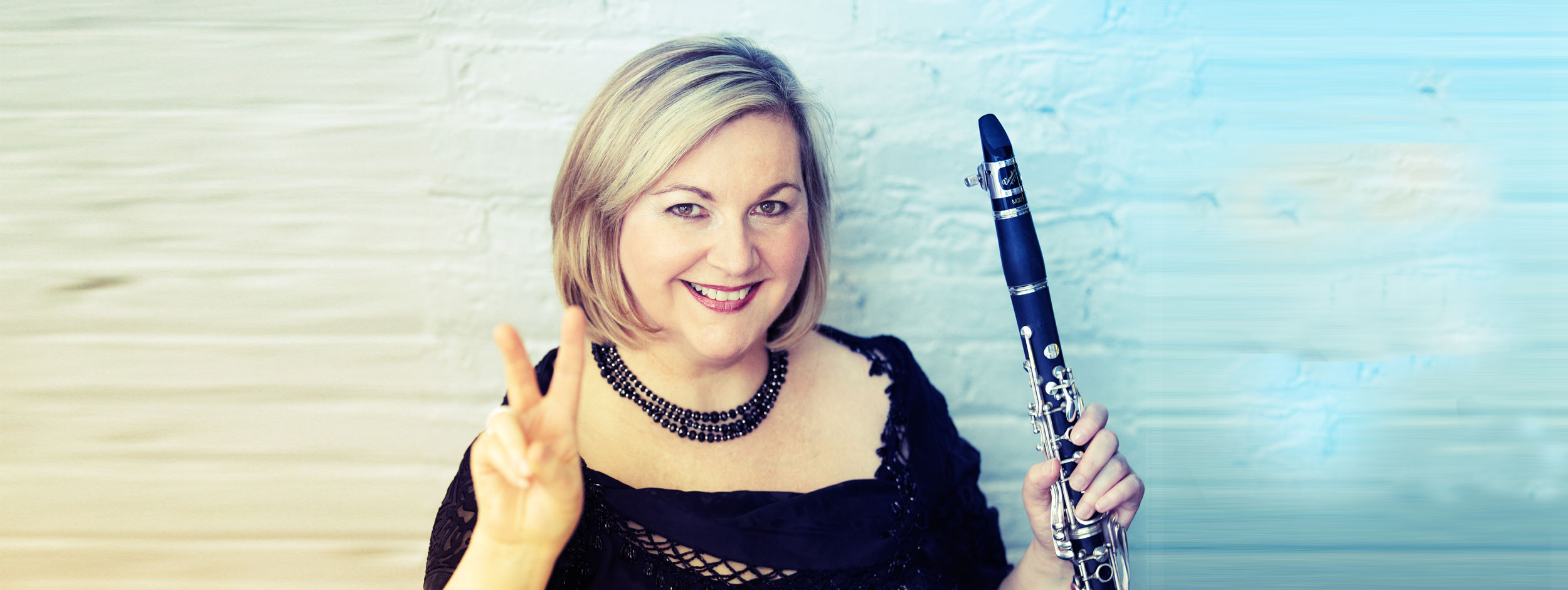
Interview conducted by Jenny Maclay
How did you establish yourself as a solo artist?
Caroline Hartig: I love to play the clarinet and have a strong passion for music and my vehicle of expression is the clarinet; the woodwind instrument that has the greatest range and most colors.
My primary goal has always been to become the best clarinetist possible and to stretch myself as an artist and also stretch the envelope of what the clarinet can do today. Although I did not set out to become a solo artist, my passion for the clarinet presented me with many solo opportunities.
In working to extend the repertoire for the clarinet in the solo clarinet genre, I became known for my solo work through my recordings and commissioning projects. Basically, I loved practicing from the minute my Dad bought my first clarinet for me in the sixth grade; I do love to play solo and did that from an early age, so playing solo and recording is a natural fit for me.
Who are your musical inspirations?
There are so many, it’s hard to name them all. I would say my greatest inspirations include composers and performers many of whom, but not all, are clarinetists.
Besides all of the great clarinetists including my wonderful teachers, I have learned a great deal from non-clarinetists as well, including mentors such as the late Sam Baron, flutist, violinist Roman Totenberg, pianists Artur Balsam and Seymour Lipkin. I love Brahms, Prokofiev, Mozart, Beethoven, Bartok and composers of our day including Libby Larsen, Donald Martino, William Bolcom, Augusta Reade Thomas, Franco Donatoni, Ida Gotkovsky, Edison Denissow and on and on.
How is the life of a soloist different than that of an orchestral clarinetist?
The repertoire is different of course and in solo playing, one has a bit more latitude and creative freedom than in orchestral or chamber, however, our goals are all the same…to play the clarinet well and deliver what the composer intended.
I think creativity comes from consummate control of the instrument so orchestral study is a must to gain the rhythmic and technical command that is necessary in all facets of performance.
"I think creativity comes from consummate control of the instrument..." - Caroline Hartig
Your CDs feature contemporary works – why do you think it is important to advocate for this new music?
Because these works stretch the boundaries of what the player and clarinet can do today and in the future. A cursory glance of the repertoire composed over the years is proof of how the clarinet has developed and continues to be the gem of the woodwind family; and, an instrument which has inspired and is desired as a creative tool for masterworks by the greatest composers past, present and future.
It is also important to inspire young talented clarinetists and composers to create more of these masterworks and to showcase the lyrical and virtuosic possibilities of the clarinet.
A solo clarinet career is difficult to achieve – how can solo clarinetists compete with traditional solo instruments, such as violin and piano?
In the 18th and 19th centuries, the clarinet was considered one of the most virtuosic and lyrical instruments, and shared equal billing with the violin and piano; clarinetists were thought to be on more of an equal footing with violin and piano.
The most renowned composers of our time, as well as composers of earlier eras, have written major works for the clarinet, as the lyrical and virtuosic possibilities are limitless. Composers are aware of the clarinet’s flexibility, extraordinary range of colors and dynamics, and communicative character. Brahms, Mozart, Schumann and Schubert all wrote monumental solo works for the clarinet. Renowned for their virtuosity, violinist, Niccolo Paganini and pianist, Franz Liszt exceeded the technical limits of their instruments.
Inspired by these extraordinary individuals, performers of all instruments started commissioning new works designed to display their unique technical prowess. Some of the most successful composers of these works were clarinetists themselves, including such renowned virtuosi as Heinrich Baermann, his son Carl Baermann, Luigi Bassi, Ernesto Cavallini, and Carlo Della Giacoma. Works by Cavallini and Bassi can be heard on my earlier recordings and I will continue my practice of showcasing these important early composer/clarinetists in my CD, Clarinet Brilliante III.
Which piece do you enjoy performing the most and why?
CH: I enjoy pushing the envelope of what the clarinet can do, so I love to perform the standard war horse virtuoso works as well as the cutting edge new works, some of which have been written for me such as Dancing Solo, by Libby Larsen and Chalumeau, by William Bolcom. I love challenging solo works such as Clair by Donatoni and the amazing clarinet works of Ida Gotkovsky along with Denisov Sonata to name a few …and of course love all of the standards from Mozart, to Brahms, Debussy, Nielsen, and Copland and all the greats in between.
I have enjoyed performing recent concertos written for band including Daugherty’s Brooklyn Bridge with the Michigan State University Wind Symphony and recently Ticheli’s Concerto for Clarinet and Wind Symphony which I recently performed at Cleveland’s Severance Hall with The Ohio State University Wind Symphony under the direction of Russ Mikkelson, Director of Bands.
Do you have any advice for conquering performance anxiety?
Dig into the music and get into the “flow” state. Just like any great athlete, musicians do best when they are in the “flow.” When in the flow state, it is nearly impossible to be nervous because you are focusing on the music and not yourself.
Focus on communicating your musical thoughts and ideas and finding your inner voice as an artist. When in the flow state, a half hour work, for example, can feel like five minutes because the performer is totally immersed in the flow state; following the performance we may not be able to recover all the details of the performance in our memory because the performance was deep within our psyche. Usually, these are some of the greatest performances when listening back later to recordings.
Another important tip is not to judge yourself as you play and love the music you are playing. The more you perform, the less anxious you will become. The more prepared you are, the less nervous you will likely be. It helps to be over-prepared and then even if you have a little anxiety, it will leave you quickly. Actually, a little bit of anxiety or nervousness can be a good thing…use the good nervous energy to give you the edge of a great performance.
Be so skilled on your instrument in all of the fundamentals in terms of sound production, technical command, articulation, and intonation that any problem that comes up in a performance can be easily solved! Great players must be problem solvers on a very high level. We must react within seconds….It’s like putting a 2000 piece puzzle together…when it comes together, you have achieved mastery! Keep trying and NEVER GIVE UP--- AND ABOVE ALL BE PASSIONATELY COMMITTED TO THE MUSIC AND YOUR ART!!
About Caroline Hartig
Caroline Hartig is Professor of Clarinet at The Ohio State University and presently serves as President of the International Clarinet Association (ICA) An acclaimed clarinet soloist and recording artist, CAROLINE HARTIG has performed throughout the United States, Europe, and Asia. She has appeared as soloist with orchestras and contemporary music ensembles and as a recitalist in major concert halls in New York City and abroad including Carnegie Hall, Weill Recital Hall, Merkin Concert Hall, the Fritz Reiner Center for Contemporary Music, Symphony Hall (Boston); Tokyo, Japan; Munich, Germany; and Perugia, Italy. She has performed with the Indianapolis Symphony Orchestra, Indianapolis Chamber Orchestra, Boston Philharmonic and New Hampshire Music Festival Orchestra.
Hartig has performed as a guest artist for the International Clarinet Association and has been heard on National Public Radio’s Morning Edition. She may be heard on the solo compact disc Clarinet Brilliante (Centaur Records #2572) honored as a “Critics’ Choice” by the American Record Guide stating; “Hartig dazzles with numbing, blazing fluidity and rich, luxuriant fervor...coiled virtuosity.” In an Overview of Woodwind Recordings, ARG cited Clarinet Brilliante as one of the “best of the best” for the performance of clarinet solo recital literature along with legendary clarinetists, Harold Wright, David Shifrin and Ricardo Morales. “For some sweet-sounding barnburners, Caroline Hartig weaves a spellbinding recital.” Also selected as “Editor’s Choice” by Clarinet & Saxophone Magazine of Great Britain, Hartig’s artistry is described as “positively breathtaking in its scope and performance.” Her compact disc Clarinet Brilliante II (Centaur 2808) was praised by American Record Guide noting, “The playing is mastery itself...”
Widely recognized and sought after for numerous new-music collaborations, Hartig has premiered and performed solo clarinet works by leading contemporary composers including Pulitzer-Prize winners William Bolcom and Donald Martino. She can be heard on the compact disc Dancing Solo (Innova 512) featuring the solo and chamber clarinet works of composer Libby Larsen. “It is in Dancing Solo that Ms. Hartig really demonstrates her musicality and prodigious technique...simply virtuosic”(The Clarinet). Additional collaborations with Larsen include the world premiere of “Bally Deux”; a jazz/classical hybrid double concerto composed for Hartig and jazz clarinetist Eddie Daniels for the International ClarinetFest in New Orleans. Hartig’s CD Chalumeau (Centaur 2965), comprised of benchmark contemporary unaccompanied solo clarinet works including Edison Denisov, Sonate, Ida Gotkovsky, Sonate, Leslie Bassett, Soliloquies, Janos Komives, Flammes, Franco Donatoni, Clair and Bolcom’s “Chalumeau” was commissioned and premiered by Hartig in Tokyo, Japan and is published by Hal Leonard.
Her latest release, CaraClarina: Caroline Hartig plays Classical to Klezmer, Vol. 1, on the Bremen Radio Hall Records label, was recently featured in Fanfare Magazine... “Hartig is, quite simply, an amazing talent, one of the few wind players I’ve heard in the past quarter century who made me like her due to the extraordinarily high quality of her feeling and phrasing.”
Recent appearances include solo performances and master classes at the 8th International Clarinet Festival and Competition in Todi, Italy and as the guest classical clarinetist for Clarinet and Klezmer in the Galilee, Jerusalem, Israel, with concerts in major concert halls throughout Jerusalem and Tel Aviv, culminating with a finale concert at The Holocaust Memorial, Valley of the Communities, Yad Vashem, Israel's official memorial to the victims of the Holocaust, broadcast live on the radio throughout Israel.
Hartig earned degrees from New England Conservatory (MM), The Ohio State University (BME) and the State University of New York at Stony Brook (DMA). Major teachers and career mentors have included the legendary Harold Wright, Robert Marcellus, Charles Neidich, Michele Zukovsky, George Silfies, Donald McGinnis, Marshall Haddock, David Hite, and renowned pianist Artur Balsam, violinist Roman Totenberg, and flutist Sam Baron.
Previously, Hartig taught at Michigan State University, Ball State University, and Oberlin Conservatory. In addition to an active solo and recording career, she is in demand as a master teacher and clinician and has served as a juror for performance competitions including the International Clarinet Association Young Artist Competition, the Fulbright Panel for Wind Instruments in New York City, and has been a guest clinician at the International Midwest Band and Orchestra Conference.Hartig served as artistic director of the International Clarinet Association Mid-America Festival 2015, hosted at The Ohio State University in conjunction with its annual Clarinet Spectacular.