Social Media, Teaching Philosophies, and Travel with Alex Fiterstein
Date Posted: November 16, 2017
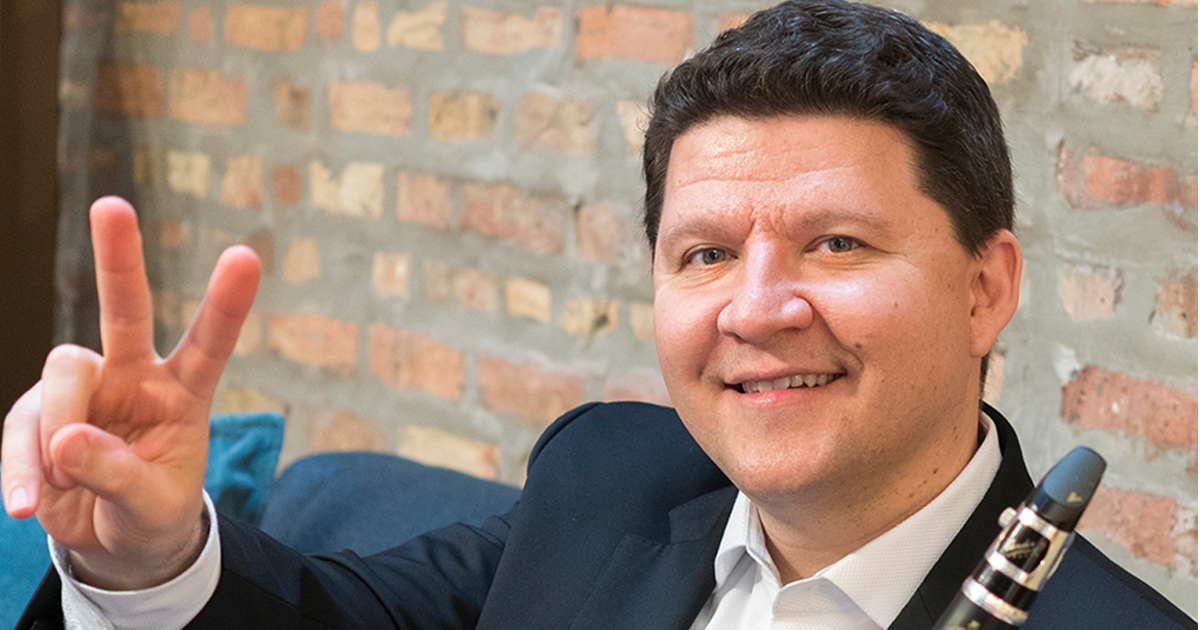
We recently have seen your videos playing excerpts on social media, what sparked you to make those clips?
I thought it would be useful to play small sections of music and give tips to people who might be interested in how to practice certain things.
I included a little bit of text with each one and I thought it would be a good way to reach more people and extend my followers, and it’s actually been really good in that regard. I’m just experimenting at this point but I think that it could be a way both for recruiting, because I will be teaching at the Peabody Conservatory in the fall and I’ve been at the University of Minnesota, so I’ve been teaching for a while, but I also thought these would be helpful for performances.
If it can help different people in some way then that’s even better, so that’s basically been the idea behind it.
Have students or followers been commenting on a lot of these videos?
I've had a ton of views and I’ve been able to get a lot of followers just in doing those types of postings, so I’m assuming people like them, or at least don’t mind them.
When you’re recording something for social media, do you have any audio concerns with how the excerpt will sound through someone’s cell phone or however they may be listening?
Sure, I think with Instagram that because it’s such a short time frame, I believe the limit is one minute, I find that it doesn’t bother me as much. I basically do the recordings on a small stand, just using an iPhone, so it really doesn’t concern me all too much.
If I were to do a longer video, maybe ten to fifteen minutes of explaining different things or playing an entire piece, then I would try to get a higher quality sound. For this purpose, I think it’s okay.
What have your teaching philosophies and methods been like while teaching?
I would say that my general philosophy is that each student is in an entirely different place in terms of where they are in their playing.
I try to first see where the student is and assess their level of playing and strength of the particular student. I will try to develop them as an artist, with more emphasis on artistic aspects such as phrasing, knowing more about the composer and some of their other pieces.
Say they are working on a Brahms Sonata, we’ll be talking about having more context in terms of the composer. When thinking about developing their skills over time, everyone’s different, so it’s really about working with the individual. It all depends on their personality; some are more receptive than others. Some students make progress quickly and with others it may take a while and then all of a sudden they have a big jump after figuring something out and it becomes a lot easier for them.
To be able to see that process happen makes teaching interesting and exciting. I recently had a student who won the school’s concerto competition, which was open to all instruments, and she was one of the two selected winners and she got to play the Copland Concerto. Seeing her come from where she started to playing the Copland Concerto was a fun process to see. She gave a really compelling performance not just technically but visually too. The way it all came across was great to see as a teacher.
"When thinking about developing their skills over time, everyone’s different, so it’s really about working with the individual." - Alex Fiterstein
What’s it like as a teacher to see that type of progression from a student, what do you feel?
It’s a great feeling, I like to think that I had a part in it. You really think, 'Wow I was able to help them a little bit there!' Which makes you feel great.
You also will see the student bring something to the table that only they can bring, stuff that’s so individual when they play things you stop and say to yourself, “Wow I didn’t even think about that!” So as a teacher you’re also constantly learning from the student. You have so much information coming at you just from watching and listening, but it really comes down to having a personal rapport with the student.
Having a respectful relationship where the student is open to learning new things and is respectful by taking the time to consider everything you say can produce some amazing results.
Other times when the connection is not ideal, like if there’s a bit of resistance, you can definitely tell that the student may be developing as well. Although in most cases I would say that you (as a teacher) find ways to reach the student, and eventually there will be growth that happens, but sometimes you just have to wait for it to happen.
When doing masterclasses overseas, is there ever a little bit of a language barrier? How do you manage?
That’s a great question because I’ve done a lot of masterclasses in different countries. I once did a masterclass in St. Petersburg, Russia and it was interesting because I speak Russian, but because it’s not perfect I thought, “Okay I’ll need a translator for this.” So they offered a translator and I noticed that the stuff I was saying to her was not getting translated exactly right. The things I was saying were somewhat getting lost in translation. I could understand the things the translator was saying to the students, mostly, and I could tell that it wasn’t quite what I meant.
So I bet a lot of that actually happens like when you’re doing a masterclass in an Eastern country, you don’t know what the translator is really saying. But I do believe that music is such a universal language that if you can demonstrate yourself a little bit more to get the message across.
So in those types of situations, I will play a little bit more, and show more with my hands like it’s a rhythm-type thing, rather than speak. If I’m doing a masterclass in the US like at a university or something, I could speak for fifteen minutes, and I know that everything I’m saying is going to have an impact on the student because we speak the same language.
But I feel that in those translation-type of situations they get the more simple type of things like if you say, “Get louder,” or, “Get softer.” However, if I were to say something more complicated than that, then there’s a risk that the message won’t come across how you intended. So when I’m in China, I think I will do a lot more demonstrations and keep any of the spoken comments a lot more simple.
About Alexander Fiterstein
Clarinetist Alexander Fiterstein is considered one of today’s most exceptional artists. Fiterstein has performed in recital, with distinguished orchestras, and with chamber music ensembles throughout the world. He won first prize at the Carl Nielsen International Clarinet Competition and received the prestigious Avery Fisher Career Grant Award. The Washington Post has described his playing as “dazzling in its spectrum of colors, agility, and range. Every sound he makes is finely measured without inhibiting expressiveness” and The New York Times described him as “a clarinetist with a warm tone and powerful technique.”
As soloist he has appeared with the Czech, Israel, Vienna, and St. Paul Chamber Orchestras, Belgrade Philharmonic, Danish National Radio Symphony, Tokyo Philharmonic, China National Symphony Orchestra, KBS Orchestra of South Korea, Jerusalem Symphony, Orchestra of St. Luke’s at Lincoln Center, Kansas City Symphony, and the Simon Bolivar Symphony Orchestra of Venezuela. During the 2015-16 season he performed as soloist with the St. Paul Chamber Orchestra on tour to Asia with concerts in Taiwan, Singapore, and Indonesia. He has performed in recital on the Music at the Supreme Court Series, the Celebrity Series in Boston, the Isabella Stewart Gardner Museum, the Kennedy Center, the Louvre in Paris, Suntory Hall in Tokyo, Tel Aviv Museum, and NYC’s 92d Street Y.
A dedicated performer of chamber music, Fiterstein frequently collaborates with distinguished artists and ensembles and regularly performs with the prestigious Chamber Music Society of Lincoln Center. Among the highly regarded artists he has performed with are Daniel Barenboim, Yefim Bronfman, Mitsuko Uchida, Richard Goode, Emanuel Ax, Marc-Andre Hamelin, Pinchas Zukerman, and Steven Isserlis. Fiterstein performed with the Dover, Pacifica, Jerusalem, and Shanghai String Quartets as well as with Ensemble Wien-Berlin. He spent five summers at the Marlboro Music Festival and appeared at the Caramoor, Moab, Music@Menlo, Montreal, Toronto, Jerusalem, and Storioni Chamber Music Festivals. He is currently co-artistic director of the Sedona Winter MusicFest in Arizona.
Fiterstein is a founder of the Zimro Project, a unique ensemble dedicated to incorporating Jewish art music into chamber music programs. He performed as principal clarinet of the West-East Divan Orchestra at the invitation of Daniel Barenboim and has appeared as guest principal clarinet with the Israel Philharmonic with Zubin Mehta, KBS Orchestra with Yoel Levi, and with the St. Paul and Orpheus Chamber Orchestras.
Fiterstein has a prolific recording career and has worked with composers John Corigliano and Osvaldo Golijov and had pieces written for him by Samuel Adler, Mason Bates, Paul Schoenfield, and Chris Brubeck, among others. His most recent recording released by Naxos is a performance of Sean Hickey’s Concerto for Clarinet and Orchestra with the St. Petersburg State Academic Symphony. Fiterstein was born in Belarus and immigrated to Israel at the age of 2 with his family. He graduated from the Juilliard School and won first prize at the Young Concert Artists International Auditions. An award recipient of the America-Israel Cultural Foundation, he previously served as clarinet professor at the University of North Carolina School of the Arts and the University of Minnesota. Fiterstein is a Buffet Crampon and Vandoren Performing Artist.