Read the Article
The Clarinet in the New York Commercial Recording Studio (Part 1)
by Mitchell Estrin
Date Posted: August 05, 2020
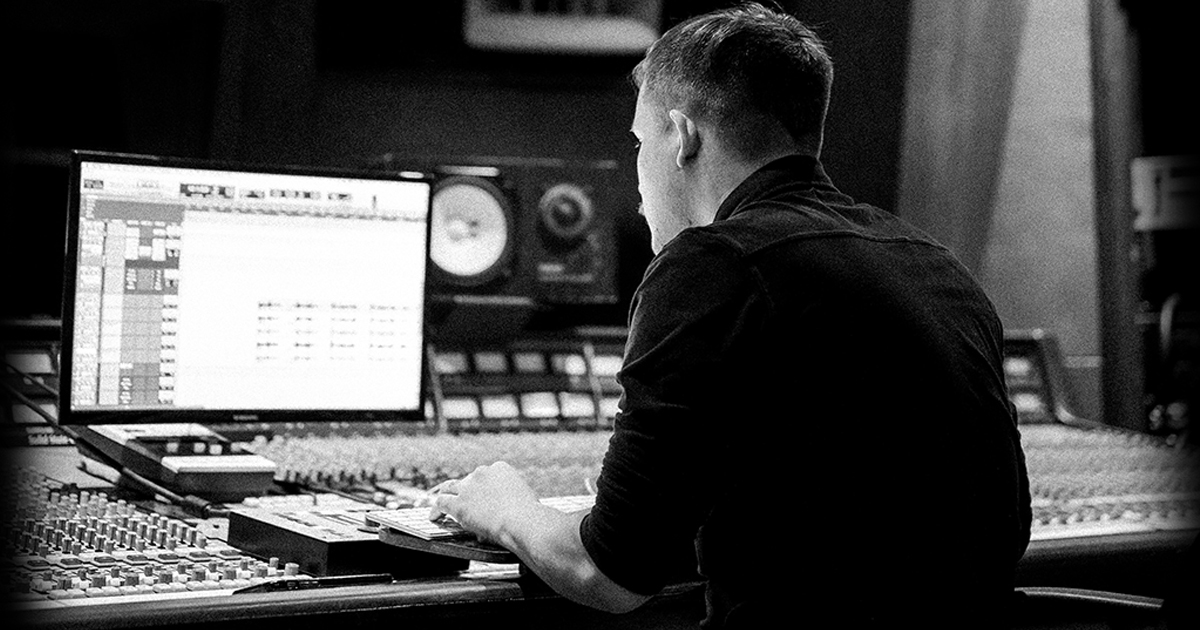
Photo by Jeffery Erhunse
During my years living in New York City, I was very fortunate to be a first call clarinetist for commercial recording work. This encompassed the years 1975-2000 and was during an era when studio recordings for television/radio commercials and motion picture soundtracks were commonplace. The advent of synthesizers, computer music, and the home studio have significantly decreased the number of recording sessions performed in recording studios by live musicians. I’d like to share some of the history and my recollections of being a part of a flourishing time in this amazing industry. Part 1 will focus on television/radio commercials and I will write about my experiences recording motion picture soundtracks in Part 2.
The Beginning
New York City is home to Madison Avenue, where the world’s leading advertising agencies are located. It was a natural outgrowth of the booming advertising industry to produce radio and television commercials in New York City. From the late 1950s until the early 2000s, these agencies produced thousands of commercials and most included a musical score, known in the industry as “jingles.”
The typical length for a commercial was either 30 or 60 seconds, and the advertising agencies would select from an established group of exceptionally talented composers who were experts at writing these 30 and 60 second jingles. Some of these composers were known for writing dramatic music, others for humorous music, while still others were known for writing a brilliant handful of notes that would become synonymous with a particular product. Think of such catchy tunes as the seven note Nationwide is On Your Side, nine note Like a Good Neighbor, State Farm is There, or twelve note Frosted Lucky Charms, They’re Magically Delicious.
Jingle Playing
I played in hundreds of jingles ranging from Aim Toothpaste to Xerox – airlines, beer, cars, cereals, detergents, drugs, insurance, you name it.
The sessions were typically one hour with a possible 20. This meant you were guaranteed one hour of recording and the producer or leader (this was most often the composer who also conducted) had the option to call the extra 20 minutes. Sometimes, you would be done in less than 10 minutes and be paid for the whole hour, while other times you could be there for the full 80 minutes. You never saw the music before you walked in to the studio, and often it was still being written when you arrived to warm-up. Recording musicians often joked that playing jingles was 99% taking candy from a baby and 1% sheer terror.
Most of the time, the music was not too technically difficult, but always required excellent pitch, rhythm, and style from the first reading. You had to be comfortable playing with headphones on and with a click track (imagine a metronome playing in the headphones). You never knew the instrumentation ahead of the session, so you could be part of an ensemble or the only instrument.
Time is money in the studio, so if you were not a good sight-reader with steel nerves, you didn’t last very long. The leaders knew who the players were who could read, nail it every time, and play in any musical style.
In my early years of jingle playing, you would most often record with an ensemble of musicians all recording together. As the larger studios began closing one-by-one, it became just as likely that you would record in a smaller studio with a handful of players (or even by yourself), overdubbing your part to a pre-recorded track.
Typically these sessions were layered post-production, combining the tracks for strings, woodwinds, brass, percussion, rhythm section, and singers to create the final product. Sometimes you could be asked to perform multiple parts – in my case clarinet 1 and clarinet 2 – and record each part along with the pre-recorded track. In this case, you would receive two session payments.
At each recording session, and depending on the original session booking time length, you could record a specified number of commercials, known as “spots.” Most often, you would record additional versions of the jingle with varying durations, usually 15, 30, or 60 seconds long.
Pro Tips at Recording Sessions
At the recording session, sometimes you had time to go in to the studio to set-up and play a few notes, and other times another group would finish recording and you would be called in to start almost immediately. For this reason, I would warm-up at home and leave my moistened reed ready to go on the mouthpiece. You had to be very careful walking in and around the studio, as you were in the midst of a myriad of wires, fragile and expensive recording equipment, and valuable musical instruments.
The engineers knew which microphones were best for each instrument and would have the room set up accordingly. You learned quickly the nuances of how to play in front of a microphone. Producing a pure and clean sound was important. I made sure the studio technician would aim the mic between my two hands on the clarinet and approximately 18 inches from my playing position, as I found this positioning to be optimal for jingle recording.
- If I had a solo passage, rather than playing louder to be heard, I would just lean in a little closer to the mic.
- An experienced session player would only have the headphones covering one ear, leaving the other ear uncovered to be able to listen better to themselves and to the rest of the ensemble.
- A pencil and working eraser were a must, as the composers often made changes to notes and rhythms on the fly.
- I also carried pre-printed and filled out IRS W-4 forms that I could just add the date and leave on my stand at the end of the session. These were just a few of the tricks of the trade.
Sometimes there was a video monitor in the studio and you could see the film while recording. I marveled at the amazing skill and creativity of the composers. As I became more established, I would often venture into the booth between takes to listen to the playback and watch the commercial. If I had a solo part and knew the recording engineer, I would sometimes ask for a copy of the audio recording. I still have some of these cassette recordings in my collection.
"I’d like to share some of the history and my recollections of being a part of a flourishing time in this amazing industry." - Mitchell Estrin
Payment Structure: 1970s vs Now
When I began playing jingles in the 1970s, the hourly rate for musicians specified in the collective bargaining agreement with the American Federation of Musicians was $56. This has increased incrementally over the years and is $133 per hour today. If the jingle stayed on-air beyond 13 weeks, for every subsequent 13 week cycle you received a re-use payment called a residual. This payment was typically 75% of the initial payment, so these “resids” could add up over time. Sometimes after the recording session, the advertising agency would use the same music for different commercials for the same product. A new spot could be created by changing the accompanying film, narration, length, or any other alteration to the original commercial.
Musicians received a 75% residual payment for each spot for every 13-week cycle it was played on air. A few times, I was lucky enough to play a one hour jingle and afterward the agency made a dozen (or more!) spots from the original recording of the commercial. Jingle musicians dreaded hearing sleigh bells as we knew the jingle and accompanying spots would only be seasonal and most likely not make it past the 13 week cycle. On a few occasions, I was happily surprised when the agency used the same commercial for the following year. I remember one Pillsbury Halloween spot that was used every October for over a decade.
The NYC Pros
The pool of jingle musicians in New York City during that era was comprised of world class players. Some were from the Lincoln Center constituent ensembles – New York Philharmonic, Metropolitan Opera, New York City Ballet, and New York City Opera – some were from Broadway, and others were top freelancers. There was a great deal of respect, professionalism, and camaraderie among the musicians. All of the recording musicians were on the roster of the preeminent commercial music booking service, Radio & TV Registry. The “Registry” roster was referred to by musical contractors when hiring musicians for a recording session. Once the contractor received an instrumentation list from the composer, she/he would make the personnel list and send it over to Registry and their staff would put out the calls to the musicians.
Radio Registry
A typical call from Registry would sound like this: Hi Mitch, this is Maryanne from Radio Registry. I have a 10-11 with a possible 20 from Emile Charlap on Wednesday, March 2 at Automated Studio A on clarinet. Are you good for that? You would either accept (“I’m good for that”), turn-down (“sorry that’s an NG”), or occasionally “put it on hold” specifying when you would give a definite answer, but generally within 24 hours.
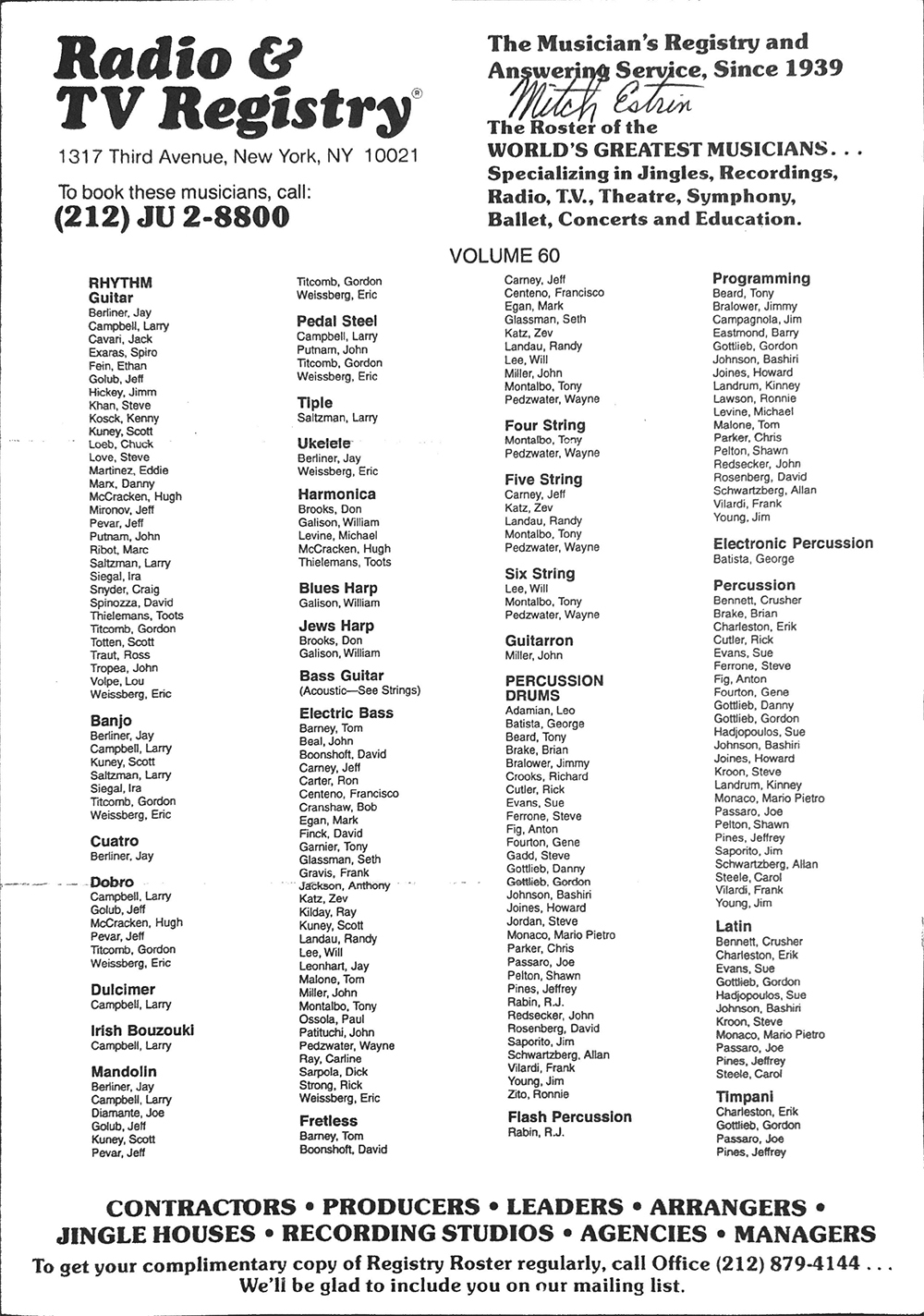
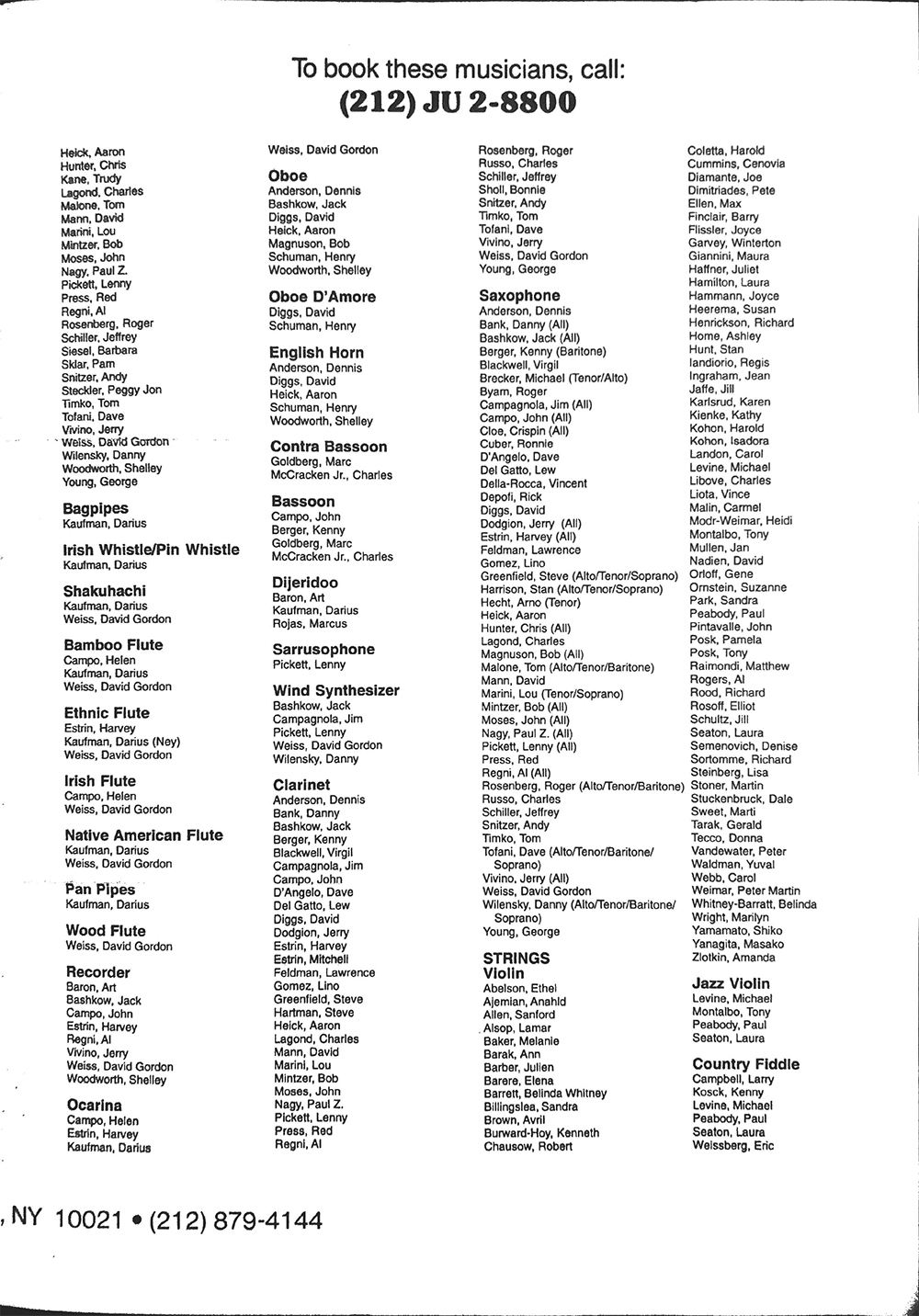
There were about a dozen studios in midtown Manhattan that were busy recording jingles Monday through Friday. Sadly, most, if not all of them, are closed now. Through the years you got to know everyone who worked in the studios - musicians, engineers, technical staff, administrators, and office personnel. It was a cutting-edge business where time was money and these highly-skilled professionals collaborated to produce music heard by millions around the world.
Click Below for Part Two: The Clarinet in Commercial Recording

About the Author
Mitchell Estrin is Professor of Music Emeritus at the University of Florida where he was founder and music director of the University of Florida Clarinet Ensemble and a University of Florida Research Foundation Professor. He served as the Artistic Director of the Vandoren Clarinet Ensemble Festival and was founder of the Buffet Crampon USA Summer Clarinet Academy. Prof. Estrin was the 20th President of the International Clarinet Association (ICA). He is the author of the biography Stanley Drucker, Clarinet Master published by Carl Fischer and Writing the Vandoren WAVE published by CAMco. His critical edition of the Weber Concertino for Clarinet, Op. 26 is published by Jeanné.
Prof. Estrin is a 2023 recipient of Honorary Membership in the International Clarinet Association. This accolade, marking the highest honor in the clarinet world, is said to acknowledge individuals with a distinguished background in the areas of professional service, teaching, performance, and lifetime achievements.
Mitchell Estrin studied clarinet with Stanley Drucker at The Juilliard School where he received his bachelor’s and master’s degrees. His other influential teachers include Jerome Stowell, Walter Wollwage, Leon Russianoff, Larry Combs, Robert Bloom, and John Moses.
Prior to his academic appointments, he had a 25-year association with the New York Philharmonic. He performed in hundreds of concerts and on 19 international tours with the Philharmonic as principal, second, and E-flat clarinetist under music directors Alan Gilbert, Lorin Maazel, Kurt Masur, Zubin Mehta, Pierre Boulez, Leonard Bernstein, and many distinguished guest conductors including Erich Leinsdorf, Sir Georg Solti, Claudio Abbado, Klaus Tennstedt, Andre Previn, Sir Colin Davis, and Leonard Slatkin. He performed on dozens of recordings with the Philharmonic and on numerous occasions performed with the orchestra on the PBS award winning series, Live From Lincoln Center.
As an international concert artist, Mitchell Estrin has performed in over 40 countries on 5 continents. He performed and recorded the world premiere of The Shadows of October for clarinet and orchestra by Michael Whalen with the Janacek Philharmonic.
“This beautiful and lushly scored tonal piece…. is performed by clarinetist Mitchell Estrin…. He plays beautifully with a lovely colored tone.”
The Clarinet
As a chamber musician, he has performed with such notable ensembles as The Chamber Music Society of Lincoln Center, New Arts Trio, American Chamber Winds, at the Newport Music Festival, and was a founding member of the Amadeus Ensemble.
Prof. Estrin has an extensive discography of solo and chamber music and recorded hundreds of television commercials and Hollywood motion-picture soundtracks. He has performed and recorded with many leading popular artists including Emerson, Lake and Palmer, Peter, Paul and Mary, Ray Charles, The Fugees, Wynton Marsalis, Benny Golson, Smashing Pumpkins, and Natalie Merchant. His motion picture soundtrack credits include recordings for Columbia, Walt Disney, Paramount, MGM, 20th Century Fox, United Artists, and Warner Brothers on feature films including Aladdin, Beauty and the Beast, The Alamo, Intolerable Cruelty, The Score, You’ve Got Mail, Primary Colors, Fargo, Batman Forever, Interview with the Vampire, Home Alone 2, Pocahontas, Doc Hollywood, Regarding Henry, The Untouchables, Reds, and Dressed to Kill. His television credits include recordings for ABC, NBC, CBS, CNN, HBO, TBS, and ESPN. Prof. Estrin was principal clarinetist for the NBC 75th Anniversary Special; broadcast from the famed NBC Studio 8H in New York City. He has appeared on The Late Show with David Letterman, The Phil Donahue Show, the television series Nurse, and in Kramer vs. Kramer, the 1980 Academy Award Winner for Best Picture. His clarinet playing has also been heard on hundreds of television and radio commercials. The National Academy of Recording Arts and Sciences recognized him as a Most Valuable Player nominee for his outstanding performances in the recording studio.
Prof. Estrin has presented recitals, masterclasses, workshops, and seminars at many prestigious educational conferences and institutions. This list includes the Eastman School of Music, Peabody Conservatory, Arizona State University, Florida State University, University of Maryland, University of Alabama, University of Arizona, University of Illinois, University of Texas, Texas State University, Texas A&M University, Midwest Clinic, New York State School Music Association, Connecticut School Music Association, and Florida Music Educators Association. In 2019, he was a guest clinician in Australia at the University of Melbourne. He has performed in recital with clarinetists Stanley Drucker, Karl Leister, and Mark Nuccio.
Widely acclaimed as a conductor and proponent of the clarinet choir, Prof. Estrin has served as director of the International Clarinet Association ClarinetFest® College, Festival, and Professors Clarinet Choirs, Texas State Clarinet Fiesta Clarinet Choir, Oklahoma Clarinet Symposium Clarinet Choir, Texas Clarinet Colloquium Clarinet Choir, and United States Navy Clarinet Choir. He held a Guinness World Record for conducting the world’s largest clarinet choir (367 members) in 2019. He has conducted the University of Florida Clarinet Ensemble throughout the United States and Europe, including three feature recitals at the International Clarinet Association ClarinetFest®. The ensemble has produced four critically acclaimed CD’s for Mark Masters, Christmas Clarinets (2016), Clarinet Choir Classics (2012), Clarinet Thunder (2009), and Wind in the Reeds (2006). Each of these recordings was selected for the Grammy Nomination eligibility list. Prof. Estrin has authored multiple articles on the history, development, repertoire, and logistics of the clarinet choir.
As a music producer and annotator, he has worked on projects with such renowned artists as trombonist Joseph Alessi, jazz pianist Lynne Arriale, and saxophonist Mike Smith. He has produced five clarinet choir CDs for Mark Recording.
Prof. Estrin’s students have performed with such prestigious ensembles as the Chicago Symphony, Cleveland Orchestra, Cincinnati Symphony, Baltimore Symphony, Pittsburgh Symphony, Detroit Symphony, Louisville Orchestra, New York Pops, United States Army Band “Pershing’s Own”, United States Army Field Band, and West Point Band. His students hold educational positions at several major universities including Indiana University, University of Arizona, University of Florida, and University of South Alabama.
Mitchell Estrin is a Buffet Crampon Legacy Artist and performs exclusively on the Buffet R13 clarinet. As a Vandoren Performing Artist, he endorses and performs exclusively on Vandoren reeds (V.12) and mouthpieces (BD2). Prof. Estrin’s educational articles are published regularly in the Vandoren WAVE and his biography is listed in Who’s Who in Classical Music, Who’s Who in American Music, and Who’s Who in International Music.