Using Summer Breaks to Your Advantage
Tips for Musicians with Jan Berry Baker
Date Posted: July 27, 2016
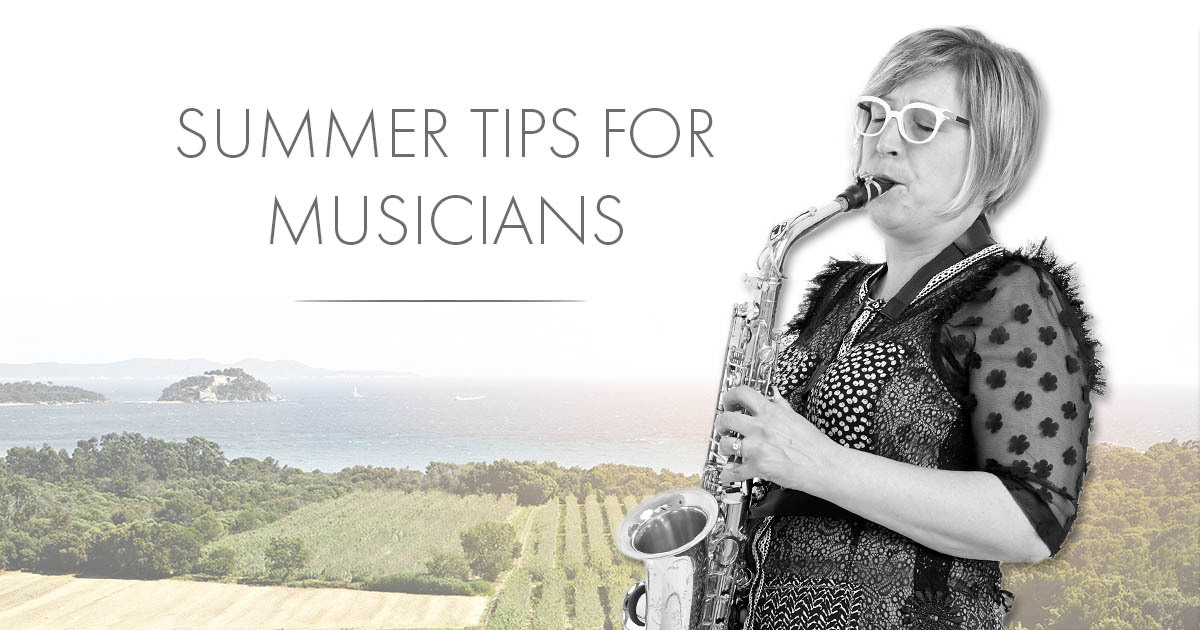
For students and teachers alike, summer break is a welcome respite from the constant pressure of deadlines, performances and the overall frantic pace of the academic year. How many times have you said, “I can’t wait until summer when I will have time to learn ______ or listen to ______? (fill in the blank with any number of things you would do if you had the luxury of time).
However, summer break is often when many students fall out of practice, get out of shape and lose their creative drive. This occurs partly because different demands and activities take over (like summer jobs) but mostly because we fall out of our routine and don’t diligently dedicate time to our creative pursuits. Suddenly, the day is gone, the week has passed and before you know it the summer is over!
Use a Creative Journal
The key to taking advantage of summer breaks (and any other breaks) is using a creativity journal. A creativity journal is a place for artists to store their creative thoughts and plans. It is not a practice journal, but more like a Pinterest board where you can save ideas and inspirations, as you find them, for future study and reference. A place to keep all the things you’d love to read, listen to, study, create – if you only had the time! It is a self-created guide for you, unique to you as it is to every artist.
The creativity journal is not a substitute for structured summer activities. Summer camps, festivals and daily practice time are essential to keeping up our chops. Make sure you schedule them in!
But we must also embrace the possibilities of unstructured creative time. It is precisely this that is missing during the rigors of the academic year. So while you don’t want to let yourself go over the summer, you also don’t want to waste the freedom it provides.
A creativity journal can be used and organized in many different ways. It is individual to the artist, and that’s the way it should be. It should not be a nagging “to-do” list, but rather a collection of ideas, thoughts and plans that fuel your creative instincts. This can include books you want to read, recordings you want to listen to, or a list of pieces or techniques you want to learn. Students may also find it useful to keep and update their short-term and long-term professional goals and any notes about how they might achieve these goals.
To get you started, here are some subgroups you might find useful:
Books and Articles to Read
New Music to Learn
- A list of pieces and composers you are interested in.
Techniques to Work on or Learn
- Include links to articles, listing of method books, practical exercises, etc.
Recordings
- A list of recordings, Soundcloud links, videos and interesting artists to listen to and study.
Upcoming Performances, Competitions, and Auditions
- A list of repertoire ideas for upcoming solo and chamber recitals
- A list of competitions, required repertoire, application and competition dates. Try the Vandoren Emerging Artist Competition!
- A list of repertoire for upcoming auditions (for advanced study as well as professional opportunities)
Summer Study
- A list of summer festivals and camps, audition and application requirements and dates
Entrepreneurial Pursuits (this category will likely have many subcategories, but here are a few ideas!)
- Creating and updating your resume
- Develop a Soundcloud page
- Create a website (as well as links to websites you like)
- Business cards and advertisement ideas
- Potential employers
- Ideas for seeking, creating and funding opportunities and creative pursuits
Short-Term and Long-Term Professional Goals
- A list of goals for the week, month, year, 5 years, etc.
Final Thoughts
Beginning a creativity journal is as easy as jotting down a recording you want to check out or making a list of repertoire you are interested in learning. Making a creativity journal should not be overwhelming or even particularly time-consuming. It should only take a few minutes every day as you record new ideas, discoveries, and creative impulses. The point is to allow yourself to have an ongoing creative conversation with yourself, so that you can develop as an artist.
The creativity journal is an antidote to the very real difficulty of dedicating time to your creative freedom every day. The daily grind of the academic year makes it hard to schedule unstructured creative time, but oddly enough the summer’s absence of immediate deadlines can often provoke procrastination. The result is the same—we tend to put off (or even fear) unstructured creative time, and for this we fail to develop as artists.
The summer is when we should engage with our creativity journals. Even as we schedule daily practice time and attend music camps and the like, we should also build in unstructured creative time. Set aside time every day for “free creativity” – listening, reading, studying a score, etc. with no rules, no expectations, just time to let your interests guide you. Read the book you found back in November! Listen to the recording you bought months ago! Make time for things that may inspire you in unexpected ways.
We all know as musicians the key to our success is our self-discipline and ability to structure our time. But we should not be afraid of unstructured time either. As artists, we must acknowledge that our creative work is not solely accomplished in the practice room or recital hall. The creativity journal should be a constant and friendly reminder that in addition to structure and rigor, we need freedom and serendipity too.
About Dr. Jan Berry Baker
Canadian American saxophonist Jan Berry Baker has performed as a soloist, chamber, and orchestral musician on many of the world’s great stages. Recent engagements include performances across the United States, Canada, Japan, Mexico, France, Germany, Scotland, England, Ukraine, Switzerland, Austria, and the Czech Republic. She has been featured as a concerto soloist with orchestras in Canada, Ukraine, USA, and most recently with the Sinfonica de Oaxaca in Mexico.
An advocate of contemporary music, Jan is Co-Artistic Director and saxophonist with Atlanta-based new music ensemble Bent Frequency. Founded in 2003, Bent Frequency brings the avant-garde to life through adventurous and socially conscious programming, cross-disciplinary collaborations, and community engagement. Committed to exploding marginalized programming in classical music, one of BF’s primary goals is championing music by women, composers of color and LGBTQIA+. In the last few years, she and Co-Artistic Director and percussionist Stuart Gerber have formed the Bent Frequency Duo Project. Together, they have commissioned over 50 new works for saxophone and percussion and have given countless performances of these works across the USA, Mexico, and Europe including their Carnegie Hall debut in 2016. Their work to fund the creation, performance and recording of new music has been supported by numerous national and international grants such as the Copland Foundation, French American Cultural Exchange (FACE), Barlow Foundation, Amphion Foundation, Ditson Foundation, Mid Atlantic Arts Foundation (National Endowment for the Arts/Andrew Mellon Foundation), and Culture Ireland to name a few.
Jan regularly performs with orchestras such as the LA Philharmonic, Lyric Opera of Chicago, Grant Park Orchestra, Chicago Philharmonic, Atlanta Opera and Atlanta Ballet and has appeared with the Chicago Symphony Orchestra, Atlanta Symphony Orchestra, Joffrey Ballet, Paris Opera Ballet, Chicago Chamber Players, and American Ballet Theater. She can be heard on American Orchestral Works with Grant Park Orchestra (Cedille), The Golden Ticket with the Atlanta Opera (Albany), The BF Duo Project recording Diamorpha (Centaur), Citizens of Nowhere featuring works for clarinet and saxophone (Albany) and is a featured performer on John Liberatore’s Line Drawings (Albany) and Robert Scott Thompson’s Folio, Vol.1, Vol. 2 and Solace (Aucourant).
As an artist and educator, Jan has held residencies at the Summer Institute for Contemporary Performance Practice (SICPP), Nürnberg Tage Aktueller Musik, Sam Houston State New Music Festival (TX), Charlotte New Music Festival, University of Georgia, New Music on the Point (VT) and Dakota Chamber Music Festival. She is highly sought after as a masterclass teacher and speaker, and has given presentations on contemporary music, entrepreneurship, nonprofits and grant writing, community engagement, socially conscious programming, career development and mentoring at major schools of music across the country.
Dr. Baker is Professor of Saxophone and Woodwind Area Head at the Herb Alpert School of Music at UCLA and currently serves as the Vice Chair of the Department of Music and Special Assistant to the Dean for Faculty Mentoring. Prior academic appointments include Georgia State University, Chicago College of Performing Arts at Roosevelt University, Northwestern University and University of Alberta. She studied with Frederick L. Hemke, William H. Street and Barbara Lorenz and earned a Doctor of Music degree in saxophone performance from Northwestern University. She is a founding member of the Committee on Gender Equity in the North American Saxophone Alliance and served as the inaugural leader of the CGE Mentoring Program. Jan Berry Baker is a Selmer Paris, Vandoren, and Key Leaves performing artist.